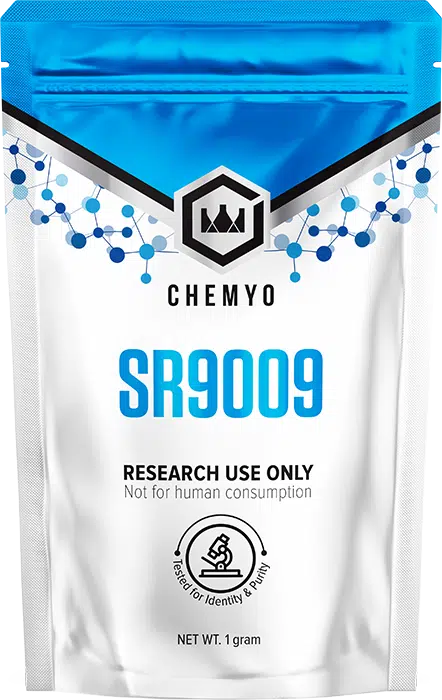
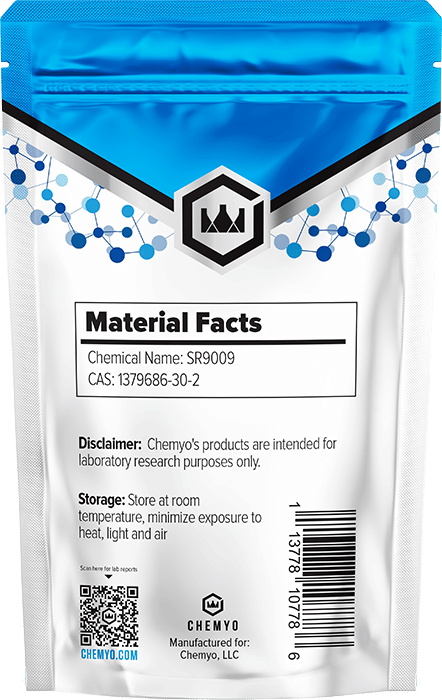
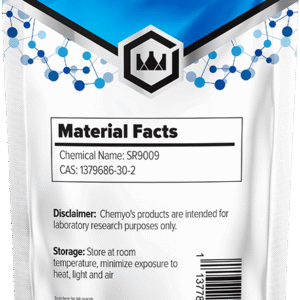
SR9009 Powder – 1g
$69.99
The Ultimate Metabolic and Circadian Rhythm Research Ligand
SR9009 Powder – 1g (Stenabolic) is a potent Rev-ErbA agonist designed for laboratories investigating metabolic homeostasis, lipid metabolism, and circadian rhythm modulation. Unlike pre-mixed solutions that can have limited shelf life, our 1g lyophilized powder provides 99% purity for precision-controlled formulation. Secure the most stable version of this compound to ensure your laboratory data remains accurate across long-term studies.
-
Purity: >99% Verified via 3rd-party HPLC and Mass Spec.
-
Format: High-stability crystalline powder (1000mg total).
-
The Chemyo Advantage: Batch-coded for full traceability and research integrity.
Researcher Note: In advanced performance-recovery protocols, SR9009 is often researched in conjunction with Chemyo Rad 140. Check any recent Chemyo Review to see why researchers trust our raw powders for their most critical experiments. Save 15% instantly by paying with Cryptocurrency at checkout.
Scientific Profile: SR9009 Powder – 1g (Stenabolic)
SR9009 is a synthetic Rev-ErbA ligand that has revolutionized the study of metabolic gene expression. By binding to the Rev-ErbAα and Rev-ErbAβ nuclear receptors, SR9009 influences the body’s internal clock and regulates genes responsible for glucose and lipid metabolism. Our SR9009 Powder – 1g is specifically curated for researchers who require the flexibility to create custom concentrations in various vehicles like DMSO or PEG-400.
Technical Specifications & Data Transparency
Research success depends on chemical accuracy. We provide the following verified technical data for every 1g vial:
| Property | Specification |
| CAS Number | 1379686-30-2 |
| Molar Mass | 437.94 g/mol |
| Chemical Formula | $C_{20}H_{24}ClN_{3}O_{4}S$ |
| Purity | >99% (HPLC Verified) |
| Form | White to off-white crystalline powder |
| Solubility | Soluble in DMSO and Ethanol |
Synergistic Applications & Chemyo Review Authority
A common focal point in modern analytical studies is the “Metabolic-Androgenic Axis.” Researchers frequently acquire SR9009 Powder – 1g alongside Chemyo Rad 140 (Testolone) to observe how circadian-linked metabolic efficiency interacts with selective androgenic stimulation.
When you read a Chemyo Review, you will find that the most successful laboratory outcomes come from using verified, batch-consistent materials. By sourcing both your Rev-ErbA agonists and SARMs from our laboratory, you eliminate the risks associated with multi-vendor purity variances.
Why Choose SR9009 Powder Over Liquid Solutions?
To outrank the competition, we emphasize the stability and customization of the 1g powder. Crystalline SR9009 is significantly more stable than liquid versions, which can be prone to degradation if not stored perfectly. By using SR9009 Powder – 1g, researchers can reconstitute exactly what they need for each phase of their study, ensuring maximum potency. This level of control is why our laboratory is the premier choice for professional research facilities worldwide.
Related products
SARMs
SARMs